Call us for a free consultation! 403.229.2774 |
  Email us at reception@canadianlegal.org
Record Suspensions and Canadian Pardons: Eligibility, Cost and Professional Assistance
A Canadian Record Suspension, formerly known as a Canadian Pardon, is a legal measure through which the Parole Board of Canada orders the record of an eligible conviction to be kept separate and apart from other criminal records held by federal departments and agencies. It does not erase the conviction, but it generally prevents the suspended record from appearing in a standard Canadian criminal record check.
This definition is based on sections 2, 2.3 and 4.1 of Canada’s Criminal Records Act.



Record Suspension at a Glance
- Eligibility: Complete every part of every sentence and the applicable waiting period.
- Waiting period: Generally three, five or ten years.
- Parole Board fee: $50.
- Our professional fee: $895 plus GST and disbursements.
- Preparation time: Commonly two to four months.
- Parole Board service standards: Six months for summary matters and 12 months for indictable matters after acceptance.
- Approval: Eligibility does not guarantee approval.
- DIY option: You can apply directly without hiring a third-party provider.
- About us: We are a one-stop Record Suspension and fingerprint company with more than 30 years of experience.
Table of Contents
- What Are the Benefits of a Record Suspension?
- Get Professional Assistance with Your Record Suspension Application
- How Much Does a Record Suspension Application Cost?
- Am I Eligible for a Canadian Record Suspension?
- Why Should I Start My Record Suspension Application Early?
- Will My Record Suspension Application Be Approved?
- What are the Steps to Apply for a Record Suspension?
- How Long Does a Record Suspension Application Take?
- What Will a Criminal Record Check Show After a Record Suspension?
- Moving Forward with Canadian Legal Resource Centre Inc.
- Frequently Asked Questions
What Are the Benefits of a Record Suspension?
A Canadian Record Suspension may reduce criminal-record-related barriers involving employment, career advancement, education, professional licensing, volunteering, housing and other opportunities. It can also provide greater confidence and peace of mind by keeping an eligible criminal record separate from active federal criminal records.
A Record Suspension is evidence that the conviction should no longer reflect adversely on the person’s character.
Learn more about the benefits of a Canadian Record Suspension.
Get Professional Assistance with Your Record Suspension Application
The Canadian Legal Resource Centre Inc. is a private Canadian company.
Since 1995, we have helped more than 1,000 clients prepare and submit their Record Suspension and Canadian Pardon applications to the Parole Board of Canada for processing.
You can apply directly to the Parole Board of Canada without hiring a third-party service provider. If you prefer professional assistance, Canadian Legal Resource Centre Inc. can help you prepare your application and navigate the application process.
Tips for Hiring a Third-Party Record Suspension Service Provider
Don’t choose a pardon company based on price alone. You’re trusting a company with sensitive personal information and an application that could affect your employment, travel and future opportunities. Compare experience, reputation, transparency and service before making your decision.
About the Canadian Legal Resource Centre Inc.
The Canadian Legal Resource Centre has been in business since 1995, offers competitive pricing, and has earned outstanding Google Reviews from our clients. You can also meet our team right here on our website. We believe you should know who you’re trusting with your personal information.
We’ve had an online presence dating back to 2000. When comparing pardon companies, check their history for yourself. Tools such as WHOIS.com can help you investigate when a company’s domain was registered.
We’re also an RCMP-accredited fingerprinting agency, which requires all of our staff to meet RCMP requirements for providing accredited fingerprinting services. To learn more about our Awards and BBB A+ Reputation check out: About Us.
Before you trust any company with your criminal record, investigate them—including us.
Keep reading to learn about eligibility, waiting periods, costs, the application process and factors that can affect the approval of your application.
How Much Does a Record Suspension Application Cost?
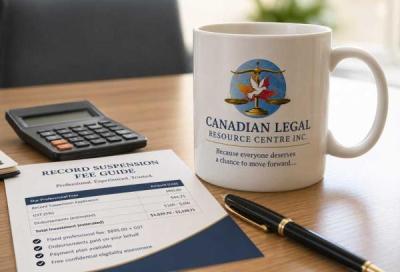
Our professional service fee is $895. GST and disbursements (see Disbursements below) are extra.
Disbursements typically range from approximately $200 to $400 but may be higher depending on the number of convictions, courts and police jurisdictions involved.
Contact us for a personalized estimate of additional costs that may apply to your case.
Disbursements typically include:
- Parole Board of Canada ($50 processing fee)
- Fingerprinting ($0 if we fingerprint you)
- RCMP fee ($25)
- Court document fees ($0 to $45 per court document depending upon Province of conviction, Saskatchewan charges $100 fee regardless of how many convictions you have)
- Local police check fees ($0 to $90 per local police check)
- Courier or optional expedited document costs
Am I Eligible for a Canadian Record Suspension?
You may be eligible to apply for a Canadian Record Suspension if you received an adult conviction under federal law, completed every part of your sentence and waited the required period.
Several factors determine your eligibility, including:
- The date of your first offence
- Whether the Crown prosecuted each offence summarily or by indictment
- The sentence the court imposed
- The date you completed every part of your sentence
- Whether any statutory exclusions apply
When Can I Apply for a Record Suspension?
Before applying, you must complete every part of every sentence. This generally includes:
- Paying all fines, costs, victim surcharges, restitution and compensation orders
- Completing every term of imprisonment or conditional sentence
- Completing parole and statutory release
- Completing all probation orders
- Completing the required waiting period
Driving and weapons prohibition orders generally do not need to expire before the waiting period begins.
You normally do not need a Record Suspension if you received only an absolute or conditional discharge or have only youth court convictions. Different rules may apply to older youth records and simple cannabis-possession convictions.
After completing all sentences for all convictions, you must complete the applicable waiting period, which is generally three, five or ten years.
Record Suspension Waiting Periods
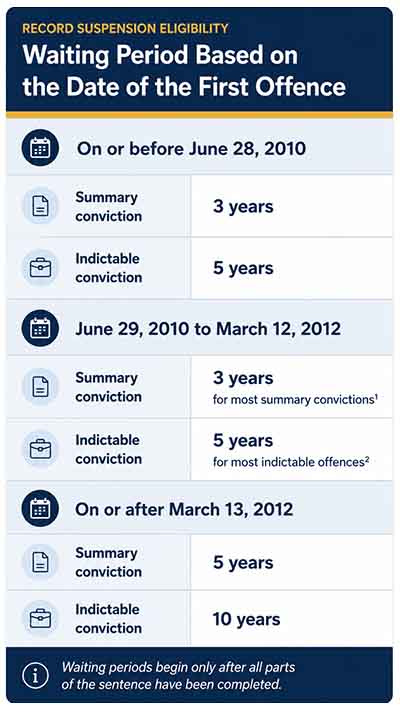
Waiting Period Based on the Date of the First Offence
| Type of offence | On or before June 28, 2010 |
June 29, 2010 to March 12, 2012 |
On or after March 13, 2012 |
|---|---|---|---|
| Summary conviction | 3 years | 3 years for most summary convictions1 | 5 years |
| Indictable conviction | 5 years | 5 years for most indictable offences2 | 10 years |
The applicable waiting period depends on when your first offence was committed and whether each offence was prosecuted summarily or by indictment.
When Does the Record Suspension Waiting Period Begin?

When does the 3, 5 or 10 year Record Suspension waiting period begin?
The waiting period begins only after you complete every part of every sentence. The eligibility rules that apply depend partly on the date of your first offence—not simply on the conviction or sentencing date.
For example, suppose you received a conviction in 2018, completed probation in 2019 and paid your fine in 2022. Your waiting period would generally begin in 2022. Even a small, overlooked fine can prevent the waiting period from starting.
The circumstances of your case may affect how these rules apply. For example, special provisions apply to certain victim surcharges and simple cannabis-possession convictions. Therefore, use the table as general guidance—not as a final eligibility decision. Weapons prohibitions and driving restrictions do not affect eligibility.
Source: Parole Board of Canada Record Suspension Application Guide, updated November 2025.
Summary, Indictable and Hybrid Offences
There are three categories of criminal offences:
- Summary offences are generally less serious and usually have shorter Record Suspension waiting periods.
- Indictable offences are generally more serious and usually have longer waiting periods.
- Hybrid offences allow the Crown to proceed either summarily or by indictment.
For Record Suspension purposes, the applicable waiting period depends on how the Crown proceeded in your case—not simply on how the offence is classified in the Criminal Code.
Your RCMP criminal record generally does not confirm whether an offence was tried summarily or by indictment. The court that handled each conviction must provide this information on the Court Information Form. If the court cannot confirm the method of trial, the Parole Board of Canada applies the longest waiting period under the applicable legislation.
Your court documents must also confirm the dates on which all fines, victim surcharges, restitution and compensation orders were paid in full.
Not sure how your offences were prosecuted or when you became eligible? Contact Canadian Legal Resource Centre Inc. at 1-800-320-2477 (toll free) or 403-229-2774 (Calgary) for a free Record Suspension eligibility assessment.
Are Any Offences Ineligible for a Record Suspension?
Some people may be legally ineligible for a Record Suspension. If your first offence was committed on or after March 13, 2012, you may be ineligible if:
- You have more than three convictions for offences prosecuted by indictment, and the court sentenced you to imprisonment for two years or more for each offence; or
- You have a conviction for an offence listed in Schedule 1 of the Criminal Records Act, which generally includes sexual offences involving a child.
A limited exception may be available for certain Schedule 1 offences if all the statutory conditions are met. Eligibility in these cases should be assessed carefully using the court documents and the applicable version of the Criminal Records Act.
Not sure how your offences were prosecuted or when you became eligible?
Contact Canadian Legal Resource Centre Inc. at 1-800-320-2477 (toll free) or 403-229-2774 (Calgary)
for a free Record Suspension eligibility assessment.
Why Should I Start My Record Suspension Application Early?
An early review of your RCMP criminal record, court information and, when appropriate, local police records, will help uncover:
- An unpaid or incorrectly recorded sentence obligation
- A conviction missing from your RCMP record
- Differences between police, court and RCMP records
- Missing, archived or destroyed court records
- Uncertainty about whether an offence proceeded summarily or by indictment
- Police information that could affect the Parole Board’s assessment of good conduct
- Your correct eligibility date
Identifying these issues early provides more time to obtain missing documents, correct errors, pay outstanding fines and determine your proper eligibility date.
When Should I Start My Record Suspension Application?
For a straightforward case, we generally recommend starting at least six months before your expected eligibility date. Older records, several convictions or convictions from multiple court locations may require a much earlier review.
It is never too early to learn how your sentences and waiting periods affect your eligibility—even if you only recently received a conviction. If you are committed to living a law-abiding life, an early review can help you understand the requirements, avoid conduct that could jeopardize a future application, and identify problems that may take months or years to resolve.
Are There Exceptions for Certain Victim Surcharges?
Yes. Victim surcharges imposed under section 737 of the Criminal Code from October 24, 2013, through December 13, 2018, are not considered when determining Record Suspension eligibility. Other fines and applicable surcharges must generally be paid in full. Parole Board of Canada—updates for applicants.
Special rules also apply to fines and victim surcharges associated solely with simple possession of cannabis convictions. These cases should be reviewed separately under the current Parole Board instructions.
What If I Am Under Investigation or Have an Outstanding Charge or Warrant?
An outstanding charge, arrest warrant or unresolved court matter generally needs to be resolved before you submit a Record Suspension application. An investigation or other police information may also affect the Parole Board’s assessment of your good conduct, even if it does not result in a charge or conviction.
You may begin preliminary records work while authorities deal with an investigation, charge or warrant. However, you should generally wait until the matter concludes before submitting your final application. You can then assess how the outcome affects your eligibility and evidence of good conduct.
If criminal proceedings are underway, speak with your criminal lawyer about how the possible sentence and whether the Crown proceeds summarily or by indictment could affect your future Record Suspension eligibility.
Will My Record Suspension Application Be Approved?
Meeting the basic eligibility requirements does not guarantee that the Parole Board of Canada will grant your Record Suspension. Eligibility means you are permitted to apply. The Board must then separately assess your conduct, circumstances and application before deciding whether to grant it.
What Does the Parole Board Consider?
Depending on the legislation that applies to your case, the Parole Board may consider:
- whether you have demonstrated good conduct and maintained a law-abiding lifestyle;
- whether granting a Record Suspension would provide a measurable benefit and sustain your rehabilitation; and
- whether granting your application would bring the administration of justice into disrepute.
How Do Good Conduct and Measurable Benefit Affect Approval?
Good conduct involves more than avoiding new criminal convictions. The Parole Board may consider charges, police reports or interventions, peace bonds, provincial offences, municipal bylaw violations and other information suggesting unlawful or concerning conduct—even if the matter did not result in a conviction.
Police contact does not automatically lead to refusal. The Parole Board considers the nature, seriousness, circumstances and timing of the conduct, any pattern of behaviour and the explanation you provide.
A measurable benefit is a specific, practical improvement you reasonably expect from receiving a Record Suspension. Your explanation should identify:
- How your criminal record currently affects you
- What practical improvement you expect
- How a Record Suspension would support your continued rehabilitation as a law-abiding citizen
For example, your record may prevent you from qualifying for a particular job, professional licence, educational program or volunteer position. Your explanation should be personal and specific rather than a general list of possible benefits.
Relevant information may include positive lifestyle changes, stable employment, family responsibilities, treatment or counselling, education, community involvement and realistic future goals.
We have assisted with more than 1,000 Record Suspension applications. This experience helps us identify conduct that may place an application at risk and assist clients in clearly explaining their measurable benefit and continued rehabilitation. When concerns exist, we can assess whether to explain them, provide supporting information or recommend more time to demonstrate good conduct before applying.
Source: Criminal Records Act, section 4.1.
What If There Is a Concern in My History?
If you are concerned that something in your history may prevent you from receiving a Record Suspension, do not assume the Parole Board will refuse your application. A past police incident, charge or other concern does not necessarily prevent approval. Contact us for your free consultation. A careful review of the circumstances, supporting evidence and legislation that apply to your case can help determine how the issue may affect your application.
What Happens If the Parole Board Proposes to Refuse My Application?
A proposed refusal is not a final refusal. It means the Parole Board of Canada has identified concerns that may prevent it from granting your Record Suspension. The Board must notify you in writing and explain why it is considering refusing your application.
You will then have an opportunity to make representations. You—or our company if you have hired us—may assist you in responding to the Board’s concerns, correct inaccurate or incomplete information, explain the circumstances and provide supporting documents. Applicants generally make representations in writing, although the Board may authorize an oral hearing. You must submit your response within the time allowed by the Parole Board.
After considering your representations, the Board will make its final decision. It may:
- Grant the Record Suspension; or
- Refuse the application.
If the Board refuses your application, you must wait one year from the date of refusal before applying again.
Applications involving a proposed refusal may take up to 24 months from the date the complete and eligible application was accepted. Criminal Records Act, section 4.2 and Parole Board processing timelines.
What Are the Steps to Apply for a Record Suspension?
To apply for a Record Suspension, you must:
- Confirm that every part of every sentence has been completed.
- Determine the applicable waiting period.
- Obtain your fingerprints and RCMP criminal record.
- Obtain court information for every conviction.
- Obtain the required local police record checks.
- Complete the Parole Board’s Record Suspension Application Form.
- Prepare any required measurable-benefit or supporting information.
- Review the application for missing or inconsistent information.
- Pay the Parole Board application fee and submit the application.
Missing, inaccurate or inconsistent information can delay your application or cause the Parole Board to return it.
Applicants may complete these steps themselves using the Parole Board of Canada’s application guide. Canadian Legal Resource Centre Inc. provides optional professional assistance for applicants who prefer help preparing and reviewing their application.
How Can Canadian Legal Resource Centre Inc. Help?
If you prefer professional assistance rather than preparing the application on your own, our experienced team can assist with the Record Suspension application process from beginning to end.
We have assisted with preparing more than 1,000 Record Suspension applications for submission to the Parole Board since 1995. This experience helps us identify issues that could affect your eligibility, delay your application or increase the risk of refusal. We can explain how police information or other concerns may affect the Parole Board’s decision and help you present the relevant circumstances clearly.
No person or company can guarantee that a Record Suspension will be granted. The Parole Board has sole authority to make the final decision. However, a concern in your history should not automatically discourage you from finding out whether you qualify. We can help you avoid preventable errors and submit a complete, carefully prepared application.
If you are uncertain about your eligibility or chances of approval, request a free, no-pressure eligibility assessment. We can review your circumstances, explain potential concerns and help you determine the appropriate next step.
How Long Does a Record Suspension Application Take?
Preparing a Record Suspension Application for submission to the Parole Board commonly takes two to four months.
If you have not yet reached your eligibility date, we may still begin the preliminary work. However, we cannot submit your final application until you have completed every part of your sentence and the applicable waiting period.
After the Parole Board of Canada accepts a complete and eligible application, its published service standards are six months for summary matters and 12 months for indictable matters. Applications involving a proposed refusal may take up to 24 months. These are service targets, not guaranteed processing times, and actual timelines may be longer due to application complexity, processing volumes or other delays.
What Will a Criminal Record Check Show After a Record Suspension?
Once the Parole Board grants a Record Suspension, the suspended conviction generally will not appear on a routine Canadian criminal record check, and the result will commonly indicate “No Record.”
A Record Suspension does not erase or destroy the conviction. It keeps the record separate and protected from routine disclosure. However, the record may become accessible if the Parole Board revokes the Record Suspension, it ceases to have effect or another legally authorized exception applies.
The type of criminal record check may also affect the result. For example, law enforcement may retain access to certain information, and an eligible vulnerable-sector check or another legal exception may permit disclosure.
Can a Suspended Record Ever Be Disclosed?
Although a suspended record does not normally appear during a routine criminal record check, access or disclosure may be permitted in limited circumstances authorized by law, including:
- When the Criminal Records Act authorizes disclosure;
- During certain vulnerable-sector checks involving specified offences and positions of trust or authority over vulnerable persons;
- When another law permits or requires access to the information; and
- If the Parole Board revokes the Record Suspension or it ceases to have effect.
Vulnerable-sector disclosure does not apply to every suspended conviction. Specific legal requirements, consent procedures and disclosure rules apply. For example, an eligible vulnerable-sector check may identify information concerning certain sexual offences.
A Record Suspension also does not cancel an existing lifetime weapons or firearms prohibition. Although the suspended conviction would not ordinarily appear on a routine RCMP criminal record check, law enforcement retains access to the active prohibition. Depending on the type of check and the police agency’s disclosure policies, a local police information check may also reveal it.
In addition, under section 6(3) of the Criminal Records Act, the Minister may approve disclosure after determining that disclosure is desirable in the interests of the administration of justice or for a purpose related to the safety or security of Canada or a country allied or associated with Canada.
Therefore, you should not describe a suspended record as erased, destroyed or impossible to find. Government agencies generally keep it separate from other criminal records and protect it from routine disclosure, subject to specific legal exceptions.
Moving Forward with Canadian Legal Resource Centre Inc.
A Message from Deborah L. Ward

Deborah L. Ward, President of Canadian Legal Resource Centre Inc.
Canadian Legal Resource Centre Inc. is a family-oriented private paralegal and RCMP-accredited fingerprinting company that has been in business since 1995.
To learn more about our company, check out: About Us
To learn more about Deborah L. Ward and our Record Suspension team, check out: About Staff
Taking the Next Step – A Record Suspension, formerly known as a Canadian Pardon, does not change the past—but it can help improve your future.
Many applicants have already taken meaningful steps forward by accepting responsibility, demonstrating good conduct and making positive changes. A Record Suspension may help remove the barriers that remain—opening the door to greater confidence, new opportunities and a future built on who you are today.
When I founded Canadian Legal Resource Centre Inc. in 1995, I believed that people who transform their lives deserve the opportunity to move forward. Since then, my team and I have had the privilege of assisting with more than 1,000 Record Suspension Applications and more than 80,000 clients across all company services. We remain committed to rehabilitation, second chances and helping people take the next step toward the life they have worked to create.
Deborah L. Ward
President and Owner
Canadian Legal Resource Centre Inc.
Last reviewed: August 2026
Reviewed by: Deborah L. Ward, President and Owner
Sources: Criminal Records Act and Parole Board of Canada application guidance
Take the Next Step: Request a Free Record Suspension Eligibility Assessment
You do not need to determine your eligibility or navigate the application process alone. Contact us for a free, no-pressure assessment. We can help you determine when you may qualify, identify issues that could affect your application and explain how we can help you move forward.
Frequently Asked Questions
Can I Qualify If I Have More Than One Conviction?
Yes. Having more than one conviction does not automatically make you ineligible. Your eligibility depends on factors such as the offences, how they were prosecuted, the sentences imposed, when they occurred and the legislation that applies. If you are uncertain, request a free eligibility assessment so we can review your record and explain whether you may qualify.
Can a Record Suspension Be Revoked?
Yes. The Parole Board may revoke a Record Suspension, and it may also cease to have effect in circumstances set out in the Criminal Records Act. If this happens, the criminal record may be reactivated in the Canadian Police Information Centre database. Criminal Records Act, section 7
Does a Record Suspension Allow Me to Enter the United States?
A Canadian Record Suspension does not guarantee entry into the United States or remove inadmissibility under U.S. law. U.S. authorities may also retain information they obtained before the Parole Board granted the Record Suspension. Depending on your circumstances, you may still need a U.S. Entry Waiver to enter the United States legally.
How Much Does a Record Suspension Cost in Canada?
The Parole Board of Canada currently charges a $50 application fee. Applicants may also pay for fingerprints, an RCMP criminal record, court documents, local police checks and delivery. Canadian Legal Resource Centre Inc.’s professional fee is $895, plus GST and disbursements.
How Long Must I Wait Before Applying for a Record Suspension?
The waiting period is generally three, five or ten years, depending on when the first offence occurred, how the Crown prosecuted the offence and the legislation that applies. The waiting period begins only after every part of every sentence has been completed.
Does a Record Suspension Erase My Criminal Record?
No. It does not erase or destroy the conviction. It generally causes the eligible record to be kept separate from active federal criminal records and prevents it from appearing on a routine Canadian criminal record check, subject to legal exceptions.
Can I Apply for a Record Suspension Myself?
Yes. You can apply directly to the Parole Board of Canada without hiring a lawyer or third-party service provider. Applicants who prefer assistance may hire a company to help prepare and review the application, but only the Parole Board can grant a Record Suspension.
Do I Need a Lawyer to Apply for a Record Suspension?
No. A lawyer is not normally required. You may prepare the application yourself or obtain optional assistance from a third-party service provider. If you choose professional assistance, compare the provider’s experience, reputation, transparency, fees and the specific services included such as on-site fingerprinting.
Can I Start My Application Before I Am Eligible?
Yes. You may begin collecting and reviewing records before your eligibility date. However, you cannot submit the final application until you have completed every part of your sentence and the applicable waiting period.